
In This Article
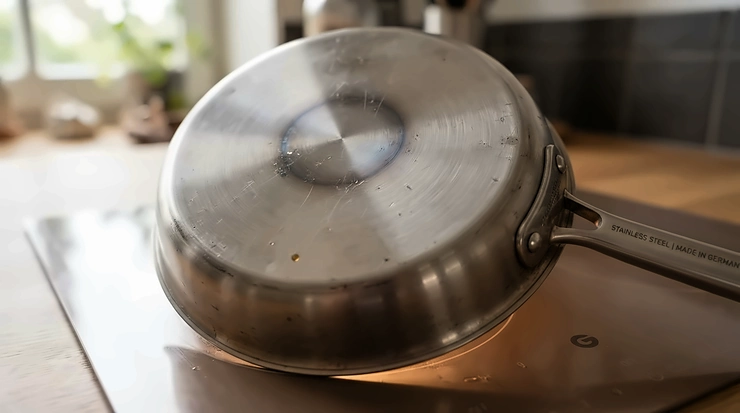
An induction compatible stainless steel pots and pans set is a collection of cookware with a magnetic stainless steel or ferrous layer in the base, so an induction cooktop’s electromagnetic field can heat the pan directly. Most quality sets pair that magnetic layer with an aluminum core for even heating and a non-reactive 18/10 interior for cooking.

Induction is the gadget that made everyone’s gas-range nostalgia look a little silly. It boils water fast and the glass stays cool enough to rest your palm on. The catch is that it only talks to magnetic metal, so a gorgeous set that sparkles on a gas flame can sit dead on an induction hob. Rhode Island’s state energy office offers a simple fix: hold a magnet to the pan, and if it sticks, you’re good to go.
Buying an induction compatible stainless steel pots and pans set is more than passing that test, though. Construction matters, and so do lids, handles, weight and warranty. A cheap disc-bottom set can pass the magnet test and still scorch your onions. This guide covers seven real sets across budget, mid-range and premium tiers, built from published specs and aggregated review sentiment, plus the buying logic the product pages leave out.
Quick Comparison: 7 Best Stainless Steel Cookware Set for Induction Cooktop Picks
Here’s the cheat sheet before we get into the details. Price ranges are approximate and shift constantly, so check current pricing before you buy.
| Set | Construction | Pieces | Price Range | Best For |
|---|---|---|---|---|
| All-Clad D3 Stainless Everyday | Tri-ply, full clad | 10 | $700-$800 range | Long-term buyers who want a lifetime heirloom |
| Made In 5-Ply Stainless | 5-ply, full clad | 10 | Premium, $700+ range | Serious searing and pro-style cooking |
| Tramontina Signature Tri-Ply Clad | Tri-ply, full clad | 12 | $300-$400 range | Best overall value |
| Cuisinart MCP-12N | Tri-ply, full clad | 12 | $250-$350 range | Mid-range all-rounders |
| Ninja EverClad | Tri-ply, full clad | 12 | $300-$400 range | High oven-heat cooks |
| T-fal Stainless Steel 11-Piece | Stainless with aluminum base | 11 | $150-$200 range | First apartments and tight budgets |
| EWFEN 3-Ply 11-Piece | Tri-ply, 304 interior, 430 exterior | 11 | $150-$250 range | Budget shoppers who want clad construction |
Looking at the table, the Tramontina Signature Tri-Ply Clad and Cuisinart MCP-12N deliver full-clad construction at roughly half the cost of the All-Clad D3 Stainless Everyday. The T-fal Stainless Steel 11-Piece is the cheapest way in, but it likely trades some evenness for that price. If you cook on induction daily, spending a bit more on clad construction is usually the smarter long-term move.
💬 Just one click — help others make better buying decisions too!😊
Top 7 Induction Compatible Stainless Steel Pots and Pans Set Picks: Expert Analysis
1. All-Clad D3 Stainless Everyday — the benchmark premium tri-ply
The “everyday” in the name is a quiet flex: this is the set other brands get compared to. It’s a 10-piece tri-ply set, with stainless steel wrapped around an aluminum core, and Reviewed named it its best stainless steel set for induction.
On paper, the full-clad build means the aluminum runs up the walls, not just across the bottom. In practice, that gives you even heat distribution all the way up the sides, which matters for sauces and shallow braises. Published specs list oven safety up to 600°F, high enough for broiler finishes and a screaming-hot sear-then-roast.
Based on the specs, this set suits cooks who plan to keep one set for decades. The brand backs it with a lifetime warranty, per roundups. Aggregated review sentiment is strongly positive, with Reviewed’s write-up noting it sears meat well and is easy to use. I couldn’t verify individual customer reviews independently, so treat that as editorial sentiment.
Pros:
- ✅ Full-clad walls give truly even heat distribution
- ✅ Oven safe to roughly 600°F
- ✅ Lifetime warranty and long track record
Cons:
- ❌ Costs several times more than budget sets
- ❌ Learning curve for stuck-on food
Price runs in the $700-$800 range at the time of research. Verdict: worth it if you cook daily and want to buy once.
2. Made In 5-Ply Stainless — thickest build for serious searing
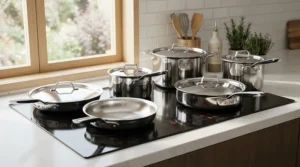
If the All-Clad is the tailored suit, this is the heavy wool overcoat. The 10-piece set includes 8″, 10″ and 12″ stainless pans, 2-quart and 4-quart saucepans and an 8-quart stockpot, all with lids.
The five-ply design layers more metal between your food and the burner. What that means in practice is better heat retention. Once the pan is hot, dropping in a cold steak doesn’t crater the temperature. The extra mass also resists warping on induction’s rapid temperature swings.
The tradeoff is weight and price. Expect pans you can feel in your wrist, which is fine for sturdy cooks and tiring for anyone with grip issues.
I couldn’t verify individual customer reviews for this set during research, so I won’t paraphrase sentiment I can’t source. What the spec sheet does support is a magnetic outer layer, thicker construction and a pan lineup covering the main stovetop jobs.
Pros:
- ✅ Five-ply build holds heat well when searing
- ✅ Sensible pan sizes and stockpot included
- ✅ Warp resistance suits induction power
Cons:
- ❌ Premium price tier
- ❌ Heavier than three-ply sets
Price sits in the premium $700+ range; check current pricing. Verdict: best for serious cooks who sear often and want a long-lasting set.
3. Tramontina Signature Tri-Ply Clad — best overall value
This is the set that makes premium buyers do a double-take. It’s a 12-piece tri-ply clad set, built in Brazil, and roundups consistently price it at well under half the All-Clad.
The full tri-ply clad construction runs the aluminum up the sides, so you get even heat distribution without the flagship price. It’s also NSF-certified, which signals sanitation-oriented design, a nice quality marker at this price.
Based on the specs, this set fits most households. Twelve pieces cover frying, sauces, stock and sautéing, and the set is listed as dishwasher safe, handy if you want to know whether the lids can go in with the plates. Reviewer sentiment in roundups lands around 4.5 out of 5 and consistently praises value over finish.
Pros:
- ✅ Full tri-ply cladding at a mid-range price
- ✅ NSF-certified build
- ✅ Dishwasher-safe lids and pans per the listing
Cons:
- ❌ Less refined finish than top-tier brands
- ❌ Handles can run warm on long simmers
Expect the $300-$400 range at the time of research. Verdict: the smartest pick for most shoppers.
4. Cuisinart MCP-12N — the dependable mid-range workhorse
Cuisinart’s MultiClad Pro line has been the “I want clad but I’m not rich” answer for years. The 12-piece MCP-12N earned Reviewed’s “best value” label among induction sets.
Its tri-ply construction pairs stainless steel with an aluminum core and oven-safe ratings in the range of 500°F, plenty for everyday roasting and finishing. The magnetic base pots and pans set approach here is full cladding, not a stuck-on disc.
Here’s what most buyers overlook: a 12-piece count includes lids, so the actual pan lineup is leaner than it sounds. Check the saucepan sizes against your habits before you click.
Aggregated sentiment across roundups is steady: reliable heat, sturdy handles and solid durability. I couldn’t verify individual review counts.
Pros:
- ✅ Full tri-ply cladding at a fair price
- ✅ Reliable heat for daily cooking
- ✅ Oven safe to about 500°F
Cons:
- ❌ Fewer premium touches than All-Clad
- ❌ Food sticks if the pan runs too hot
Price lands around the $250-$350 range. Verdict: a safe, sensible choice for steady daily cooking.
5. Ninja EverClad — oven-safe to 600°F
Ninja stormed into cookware with a clad set that borrows premium specs. The 12-piece Ninja EverClad is tri-ply with a listed oven rating of 600°F, matching the All-Clad D3 Stainless Everyday on heat tolerance.
That rating means it can handle high-heat roasting and broiler finishes without worry. It’s heavier than nonstick, and roundups recommend hand washing for the best appearance, so the dishwasher-safe lids question gets a “maybe, but handwash to keep it pretty.”
My read: this set suits cooks who like to start on the stove and finish in a very hot oven. If your cooking is mostly weeknight pasta, you’ll rarely use that headroom, and a cheaper set serves you equally well.
Reviewer sentiment from comparison roundups ranks it as a strong overall pick for even heating and durability, though I couldn’t verify individual customer reviews.
Pros:
- ✅ Oven rating up to 600°F
- ✅ Tri-ply build for even heat
- ✅ 12 pieces cover most meals
Cons:
- ❌ Handwash recommended for best finish
- ❌ Heavier than nonstick pans
Pricing lands in the $300-$400 range. Verdict: pick it if you need very high oven heat.
6. T-fal Stainless Steel 11-Piece — cheapest way into induction
Not everyone needs a cookware pension plan. This 11-piece T-fal Stainless Steel set is aimed at people who need to equip a kitchen without cashing out a retirement account.
It uses stainless steel with a heat-spreading base, listed as oven and broiler safe to 500°F and dishwasher safe. One roundup claimed it delivers a large share of premium performance at a fraction of the cost, though that’s one reviewer’s view, not a lab result.
Base-only heat spreading means the walls don’t heat as evenly as full-clad sets. For boiling pasta and frying eggs, you’ll hardly notice. For delicate sauces, you may nudge the heat lower.
Roundups cite a 4.6-star average from a large review pool, but I couldn’t independently verify those numbers.
Pros:
- ✅ Lowest price among the full sets here
- ✅ Dishwasher safe and oven safe to 500°F
- ✅ Includes steamer and sauté pan
Cons:
- ❌ Base-only heat spreading, less even on walls
- ❌ Lighter build may warp over time
Price runs in the $150-$200 range. Verdict: great starter set, though not the last one you’ll ever buy.
7. EWFEN 3-Ply 11-Piece — clad construction on a budget
The spec sheet here is surprisingly transparent. The EWFEN 3-Ply 11-Piece uses a 304 stainless interior, an aluminum core and a 430 stainless exterior, which is exactly the recipe induction wants.
That 430 outer layer is the magnetic stainless steel doing the induction work. The 304 interior stays non-reactive and easy to clean. Because it’s tri-ply, you get cladding most budget sets skip, and the listing describes it as oven and dishwasher safe.
This is a lesser-known brand, so the honest caveat is a thinner track record. Reviewers on shopping sites call it a bargain, but I couldn’t verify specific review counts, and long-term durability data is limited compared with Cuisinart MCP-12N or Tramontina Signature Tri-Ply Clad.
Pros:
- ✅ Tri-ply cladding at a budget price
- ✅ Clear 304/430 material breakdown
- ✅ Dishwasher-safe lids per listing
Cons:
- ❌ Shorter track record than established brands
- ❌ Fewer long-term durability reports
Price sits around the $150-$250 range. Verdict: smart for budget shoppers who want clad construction.
What Is a Stainless Steel Cookware Set for Induction Cooktop Use, Exactly?
Think of induction as a very polite handshake between your cooktop and your pan. A coil beneath the glass generates an alternating magnetic field, and that field creates currents inside the base of the cookware. The pan heats up, the glass barely does.
So a stainless steel cookware set for induction cooktop use needs magnetic material in the base, usually a ferritic stainless layer such as 430. Premium sets add an aluminum core, because aluminum spreads heat far better than steel but isn’t magnetic. The result is a sandwich: magnetic steel outside, aluminum in the middle, 18/10 steel inside.
Why does that matter to you? A pan that’s only partially magnetic heats in patches. A pan with no magnetic layer won’t heat at all, and your cooktop will flash an error code. Many induction cooktops also detect pan size and shut off if the base is too small or off-center.
The reverse problem exists too. A set can be “induction compatible” yet perform badly because its magnetic disc is thin and uneven. Compatibility is the entry ticket, and construction quality decides whether you actually enjoy the show.
How to Choose an Induction Compatible Stainless Steel Pots and Pans Set
Here’s a practical, six-step filter.
- Run the magnet test. If a magnet clings firmly to the bottom, the pan will work on induction. Weak or patchy pull is a red flag.
- Check the construction. Full-clad tri-ply or five-ply spreads heat up the walls. Disc-bottom designs only heat the base well.
- Count the pans, not the pieces. Lids and utensils inflate the number. A 12-piece set may hold only five or six actual vessels.
- Match sizes to your cooking. A family of four wants a 12-inch skillet and an 8-quart stockpot. A solo cook can live with less.
- Weigh the handles. Stay-cool handles help, but riveted handles trap grime. Try to see photos from several angles.
- Confirm the care rules. Check whether lids and pans are dishwasher safe and the oven rating, then compare against your habits.
Each step trims the field fast. If you cook daily, prioritize steps one and two. If you cook occasionally, prioritize step six and price.
Magnetic Stainless Steel: What “Induction Ready” Really Means
Here’s the nuance that causes the most confusion: “18/10 stainless steel” is usually non-magnetic. The 18 refers to roughly 18% chromium and the 10 to about 10% nickel, and that nickel-rich austenitic structure doesn’t attract magnets. Heritage Steel’s handbook explains that 18/10 is widely used as the interior cooking layer on multiclad cookware, while 18/0, a ferritic grade, is magnetic.
So how can a set be both 18/10 and induction friendly? It’s a layering trick. The inside is non-magnetic 18/10 for corrosion resistance and a clean cooking surface. The outside, which touches the cooktop, is magnetic stainless such as 430. Between them sits aluminum for heat spreading.
Why this matters for you: when a listing says “18/10 stainless steel” and nothing else, that’s incomplete information. Look for the words “magnetic base,” “430 exterior” or “induction compatible,” or just bring a magnet to the pan.
Also, not all magnetic stainless is equal. Some thin ferritic discs couple weakly with the cooktop, which can mean slow heating or noisy buzzing. A thicker clad structure usually behaves better, which is one reason clad sets keep topping induction roundups.
Even Heat Distribution: Clad Versus Disc-Bottom Construction
Even heat distribution is the single biggest quality gap between sets, and it’s the one product pages rarely explain.
In a disc-bottom set, a thick aluminum and steel disc is bonded to the base of the pan. Heat spreads nicely across the bottom, but the walls stay cooler. In a full-clad set, aluminum runs from rim to rim, so the whole pan heats together. That means sauces don’t scorch at the base while the sides stay lukewarm.
Why do you care? Because induction heats the pan base fast and hard. A thin base creates hot spots in seconds, and sauces and eggs will tell you about it. Aluminum cores act as a buffer, taking that intense local heat and sharing it around.
A five-ply set adds more layers for extra heat retention and warp resistance. The tradeoff is weight and price. For most home cooks, tri-ply clad sets like Tramontina Signature Tri-Ply Clad and Cuisinart MCP-12N hit the sweet spot.
Here’s the quick rule of thumb. If you sear steaks and reduce sauces often, buy clad. If you mostly boil and fry, a decent disc base such as the T-fal Stainless Steel 11-Piece is fine.
Dishwasher Safe Lids and Care: What to Know Before You Load the Rack
Dishwasher safe lids are one of those features nobody thinks about until it’s 9 p.m. and the sink is full. Here’s the honest picture.
Many stainless sets, including the T-fal Stainless Steel 11-Piece, Tramontina Signature Tri-Ply Clad and EWFEN 3-Ply 11-Piece, are listed as dishwasher safe. The All-Clad D3 Stainless Everyday is also reported as dishwasher safe by reviewers. The Ninja EverClad is the exception on this list, with roundups recommending hand washing for the best appearance.
The catch is cosmetic. Stainless itself handles the machine fine, but harsh detergents and heat can dull the finish over years, and lids with glass inserts or silicone edges may age faster. A manufacturer’s care sheet beats my summary, so read it before you commit.
Practical tips: rinse off cooked-on food before loading, skip harsh citrus-based detergents on polished steel, and dry lids promptly to prevent water spotting. If you hand wash, a paste of baking soda and water lifts most discoloration.
In short, dishwasher-safe lids are a real convenience, though they aren’t a reason to pick one set over another if everything else is equal.
✨ Don’t Miss These Exclusive Deals!
🔍 Take your kitchen to the next level with these carefully selected sets. Click on any highlighted product to check current pricing and availability. The right induction compatible stainless steel pots and pans set can make weeknight cooking faster, cleaner and a lot more fun!
Practical Usage Guide: Getting the Most From Your New Set
Even the best set needs a little technique. Here’s how to avoid the classic first-month mistakes on induction.
Start with preheating. Induction is fast. Preheat on medium for about two minutes before adding oil, then adjust. Most sticking problems come from cold food hitting a hot pan, or from pans that are too hot for the ingredient.
Use the water-drop test. A drop of water should bead and dance across the surface when the pan is ready for searing. If it sizzles and vanishes instantly, drop the heat.
Match pan to burner. The base should roughly match the burner ring. A small pan on a large zone works but can heat unevenly, and an oversized pan may heat only its center.
Lift, don’t slide. Dragging stainless across glass can scratch the cooktop. Lift pans straight up and set them down gently.
Maintain the finish. Once a month, simmer a half-and-half mix of water and white vinegar for a few minutes to remove mineral haze, then rinse and dry. For stubborn heat tint, a stainless cleaner works well.
Common mistakes in the first 30 days: cranking the heat to high out of habit, using metal tools that scratch the surface, and skipping the preheat. Fix those three and your set will feel twice as good.

Real-World Scenarios: Which Set Fits Which Cook?
Specs are abstract. Here are three profiles.
The first-apartment cook, with about $200 and a small induction range. The T-fal Stainless Steel 11-Piece or EWFEN 3-Ply 11-Piece fits. The budget is tight, the cooking is mostly pasta, eggs and stir-fries, and dishwasher-safe lids save time. The caveat is that you may eventually replace a skillet with something thicker.
The family of four, with a $300-$400 budget and daily cooking. The Tramontina Signature Tri-Ply Clad or Cuisinart MCP-12N is the logical choice. Twelve pieces mean a stockpot for chili night, two skillets and a few saucepans, while full cladding gives even heat distribution when you’re juggling three dishes.
The serious home cook, with a $700+ budget who sears steaks and reduces sauces. The All-Clad D3 Stainless Everyday or Made In 5-Ply Stainless makes sense. Better heat retention and warp resistance justify the premium if you cook five nights a week and plan to keep the set for 15 years.
In every scenario, the right set is the one that matches how often you cook and how much you value your time. A pricey set used twice a week is a poor deal. A modest set used daily is a great one.
Problem and Solution: Fixing Common Stainless Steel Headaches
Stainless steel has a reputation for being fussy, but most problems have simple fixes.
Problem: Food sticks. Solution: preheat the pan, add oil once hot and let food release naturally before flipping. Cold pans and impatient flipping cause most sticking.
Problem: The cooktop buzzes or whines. Solution: some noise is normal on induction, especially at high power, and it often comes from layered cookware vibrating. Lowering the heat usually quiets it. Constant loud noise may signal a thin base.
Problem: Rainbow or blue tint. Solution: that’s heat tint, not damage. A little white vinegar or a stainless cleaner removes it.
Problem: White spots. Solution: mineral deposits from hard water. Wipe with vinegar and dry promptly.
Problem: The pan won’t heat at all. Solution: do the magnet test. If it fails, the pan isn’t induction compatible. If it passes, check that the pan is centered and big enough for the burner zone.
The Cuisinart MCP-12N and Tramontina Signature Tri-Ply Clad are forgiving for most of these issues, thanks to their full cladding and moderate weight.
Induction Compatible Stainless Steel Pots and Pans Set vs Alternatives
Stainless isn’t the only game in town. Here’s how it compares.
| Option | Induction Ready? | Heat Evenness | Maintenance | Best For |
|---|---|---|---|---|
| Clad stainless (Tramontina Signature Tri-Ply Clad) | Yes | Excellent | Moderate | Everyday versatility |
| Premium clad (All-Clad D3 Stainless Everyday) | Yes | Excellent | Moderate | Long-term buyers |
| Nonstick, aluminum | Often no, unless base is magnetic | Good | Gentle care required | Eggs and delicate fish |
| Cast iron | Yes | Slow to heat, retains well | Seasoning required | Searing and baking |
Looking at the comparison above, stainless wins on versatility. It goes in the oven, tolerates metal tools and doesn’t need seasoning. Nonstick is easier for eggs but wears out faster, and cast iron holds heat beautifully but is heavy and needs care.
My take: a stainless set as your core, plus one nonstick skillet for eggs and one cast-iron pan for searing, covers almost every task.
Features That Actually Matter (And Those That Don’t)
Cookware marketing loves buzzwords. Here’s a quick filter.
Matter: construction (clad vs disc), a magnetic outer layer, oven rating that fits your cooking, handle comfort and a decent lid fit. These directly shape your daily experience.
Matter somewhat: dishwasher safe lids, etched fill lines and warranty length. Nice to have and worth checking, but they won’t rescue a thin pan.
Matter less than advertised: piece count, “chef-grade” claims and decorative finishes. A 21-piece set can be mostly lids and utensils, and a polished mirror finish is lovely right up until fingerprints arrive.
Often misunderstood: nonstick-style coatings on stainless sets, extra-thick bases that add weight without improving evenness and generic “non-toxic” labels. Stainless steel is inherently non-reactive, so extra health claims can be marketing rather than meaningful difference.
When comparing two sets, put construction first, then care rules, then price. Everything else is a tiebreaker.
Long-Term Cost and Maintenance: What Your Set Really Costs Over Time
Sticker price is only half the story. A $150 set that warps in three years costs more per use than a $400 set that lasts fifteen.
Let’s do rough math. Suppose a $350-range clad set lasts 15 years of regular use. That’s about $23 a year, or pennies per meal. A budget set costing $150-$200 that you replace every five years lands around $30-$40 a year, so the cheap option can quietly cost more.
Energy matters too. The U.S. Department of Energy measured induction at about 84% efficiency, versus roughly 40% for gas, according to a ProBuilder explainer, and a well-matched pan wastes even less. Figures vary by test conditions, but the direction is consistent: induction cooking is efficient, and good cookware helps it stay that way.
Maintenance is inexpensive. Mild detergent, occasional vinegar soaks and a soft sponge are all you need. Warranty strength is another long-term variable: the All-Clad D3 Stainless Everyday is reported to carry a lifetime warranty, and that can offset its higher price.
The takeaway: pay for construction, not piece count.
Frequently Asked Questions
❓ Can I use a stainless steel set on an induction cooktop without a magnetic base?
❓ Is a magnetic base pots and pans set better than full-clad construction?
❓ Are dishwasher safe lids really safe for long-term use?
❓ How do I know if my magnetic stainless steel pan will work on induction?
❓ How many pieces do I actually need in a stainless set?
Conclusion: Which Induction Compatible Stainless Steel Pots and Pans Set Should You Buy?
Induction rewards the right pan and punishes the wrong one, so choosing well pays back every single meal. The magnet test gets you through the door, but construction, care rules and honest value are what make a set worth keeping.
Here’s the short version. If you want the best value, the Tramontina Signature Tri-Ply Clad is hard to beat. For a dependable mid-range pick, the Cuisinart MCP-12N delivers. If money isn’t the limiting factor and you cook constantly, the All-Clad D3 Stainless Everyday and Made In 5-Ply Stainless are the premium choices. On a tight budget, the T-fal Stainless Steel 11-Piece and EWFEN 3-Ply 11-Piece get you cooking, and the Ninja EverClad suits cooks who love very hot ovens.
Whatever you choose, preheat patiently, lift pans instead of sliding them and keep a magnet handy for shopping. Your induction cooktop will thank you with fast, even, controllable heat.
✨ Ready to upgrade your kitchen? 🍳 Pick the set that fits your cooking style, click through to check current pricing and availability, and start cooking on induction the way it was meant to be done!
Recommended for You
- [Add your blog post link 1]
- [Add your blog post link 2]
- [Add your blog post link 3]
Disclaimer: This article contains affiliate links. As an Amazon Associate, I earn from qualifying purchases. If you purchase products through these links, we may earn a small commission at no additional cost to you.
✨ Found this helpful? Share it with your friends! 💬🤗
