
In This Article
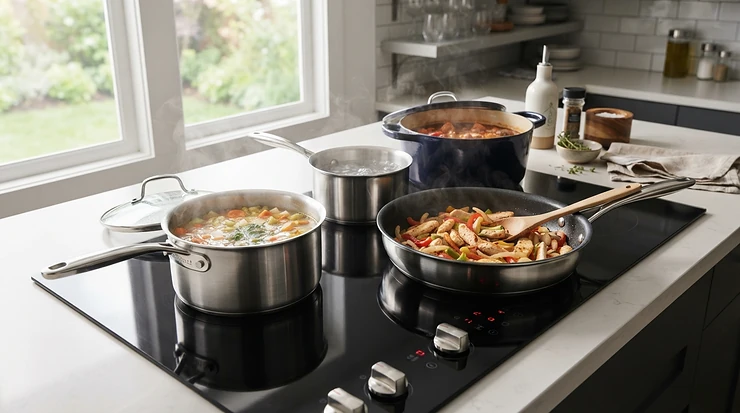
A glass top stove is the kitchen’s version of a freshly waxed car. It’s gorgeous, expensive to fix, and weirdly eager to show off every mistake. Drag the wrong pan across it and you’ve signed it permanently. Pick a warped one and dinner cooks unevenly while the base wobbles like a cheap diner table. That’s why choosing a nonstick cookware set for glass top stove use is less about brand glamour and more about geometry, materials, and a few habits that cost nothing.
What Is a Nonstick Cookware Set for Glass Top Stove Use?
A nonstick cookware set for glass top stove use is a matched collection of coated pots and pans with a perfectly flat, smooth, grit-free base that sits flush against a ceramic-glass cooktop. The coating releases food with little oil, while the base protects the glass from scratches and moves heat evenly. Most sets include fry pans, saucepans, a stockpot, and lids.
Most traditional nonstick surfaces rely on PTFE (polytetrafluoroethylene), the slippery fluoropolymer better known by the Teflon brand name. Ceramic-style coatings are the main alternative. Both can work on glass, but the pan underneath matters more than the coating on top.
One honest note before we dive in. The analysis below draws on manufacturer specs, published glass-top roundups, and aggregated review sentiment. It isn’t hands-on testing. Where I couldn’t verify a detail, I say so, and you should confirm it on the product page before buying.
Quick Comparison: 7 Nonstick Cookware Set for Glass Top Stove Options
Here’s the lineup at a glance. Price ranges are ballpark figures at the time of research and change often, so check current price before you decide.
| Set | Pieces | Body / Coating | Typical Price Range | Best For |
|---|---|---|---|---|
| T-fal Ultimate Hard Anodized 14-Piece Set | 14 | Hard-anodized aluminum, PTFE-based nonstick | $150–$220 | Families wanting one box |
| All-Clad HA1 Hard Anodized Nonstick 10-Piece Set | 10 | Hard-anodized aluminum, induction compatible | $250–$400 | Long-term buyers |
| CAROTE 16-Piece Titanium Nonstick Set | 16 | Die-cast aluminum, titanium-branded coating | $100–$160 | Best piece count per dollar |
| Rachael Ray Brights Aluminum Nonstick Set | Varies | Aluminum, nonstick interior | $100–$170 | Casual cooks, color lovers |
| Calphalon Classic 10-Piece Set | 10 | Hard-anodized aluminum, nonstick | $150–$250 | Steady everyday cooking |
| GreenLife 16-Piece Ceramic Nonstick Set | 16 | Ceramic nonstick (PTFE-free) | $100–$160 | PTFE-avoiders |
| Amazon Basics 8-Piece Nonstick Set | 8 | Aluminum, nonstick coating | $50–$90 | Starter kitchens |
Looking at the table, the CAROTE 16-Piece Titanium Nonstick Set and GreenLife 16-Piece Ceramic Nonstick Set deliver the most pieces for the least money, while the All-Clad HA1 Hard Anodized Nonstick 10-Piece Set asks for a premium and gives you fewer pieces. If you want the fewest compromises on build, the hard-anodized options from T-fal, All-Clad, and Calphalon deserve the closest look. The Amazon Basics 8-Piece Nonstick Set is the budget pick, but it’s also the one where you should inspect the base most carefully.
💬 Just one click — help others make better buying decisions too!😊
Top 7 Nonstick Cookware Set for Glass Top Stove Picks: Expert Analysis
Every pick below is judged on the same questions. Does the base look built to stay flat? Is the coating likely to survive real kitchen habits? Who actually benefits? Specs are explained in plain terms, and review sentiment is clearly labeled as aggregated, not invented.
1. T-fal Ultimate Hard Anodized 14-Piece Set — heat indicator guards the coating
The standout here is the Thermo-Spot ring in the pan’s center, a heat indicator that signals when the pan is ready. That matters more on a glass top than you’d think. Radiant elements cycle on and off, and impatient cooks tend to blast an empty pan on high, which is exactly what shortens a PTFE coating’s life. A visual cue nudges you toward patience.
The set is built from hard-anodized aluminum, and one retailer listing describes it as oven and broiler safe to 400°F and dishwasher safe. Hard anodizing hardens the aluminum, which helps the base stay rigid through repeated heat cycles. No pan is warp-proof, though. T-fal’s own materials describe its nonstick coatings as PTFE-based, so metal utensils and dry preheating stay off the menu.
This is a family-sized, one-box solution: fry pans, saucepans, a griddle, a Dutch oven, and more. Review roundups consistently credit the food release and the heat indicator, while long-term coating durability is the usual open question for any nonstick set, so treat lifespan promises skeptically.
Pros:
- ✅ Heat indicator discourages harmful dry preheating
- ✅ Broad 14-piece lineup covers most recipes
- ✅ Dishwasher-safe per retailer listing
Cons:
- ❌ Bulky storage footprint for small cabinets
- ❌ PTFE-based surface still dislikes metal utensils
Price check: around $150–$220, which is strong value if you want a complete kitchen in one purchase.
2. All-Clad HA1 Hard Anodized Nonstick 10-Piece Set — premium build, higher oven ceiling
The headline is the oven rating. One retailer listing gives the pans an oven and broiler rating of 500°F, with lids rated lower at 350°F. That lets you start a frittata on the stovetop and finish it under the broiler, a trick lesser sets can’t pull off.
The body is hard-anodized aluminum, and the set is listed as induction compatible. Induction compatibility usually implies a magnetic base layer, which tends to add stiffness and, in turn, a flatter, more stable footprint on glass. Confirm that on the box. The 500°F rating also isn’t an invitation to sear at maximum heat, because PTFE-type coatings begin to degrade near that threshold.
On paper this is the “buy it once” choice for someone who cooks often and wants fewer, better pieces. Glass-top roundups feature it prominently, but I couldn’t verify a consistent complaint or praise pattern across owner reviews, so read recent ones for coating wear before committing.
Pros:
- ✅ High oven and broiler rating for the category
- ✅ Induction-ready base suggests a rigid bottom
- ✅ Fewer filler pieces, more useful ones
Cons:
- ❌ Premium price for only ten pieces
- ❌ Lids rated well below the pans
Price check: roughly $250–$400, so it pays off only if you’ll keep and care for it for years.
3. CAROTE 16-Piece Titanium Nonstick Set — most pieces per dollar
The standout is sheer volume: sixteen pieces from a brand known for aggressive pricing. The listing describes die-cast aluminum bodies, a titanium-branded nonstick coating, induction compatibility, and a PFOS- and PFOA-free claim.
Die-cast construction is usually thicker than stamped aluminum, and a thicker base tends to resist the wobble that ruins glass-top cooking. The lightweight build is a mixed blessing. It’s easy to lift rather than drag, but light pans can slide more readily across slick glass. The coating is marketed as “titanium,” and I couldn’t confirm whether it’s PTFE-based, so check the product page if that matters to you.
This set suits first kitchens and large households that need many pots without a big spend. One glass-top roundup rates it around 4.6 out of 5 and notes that the base sits flush on a cooktop, though single-site ratings deserve a grain of salt.
Pros:
- ✅ Sixteen pieces cover nearly every recipe
- ✅ Induction-compatible base listed by the brand
- ✅ Lightweight pieces lift easily off glass
Cons:
- ❌ Coating chemistry is unclear from the marketing
- ❌ Lightweight pans can slide on slick glass
Price check: around $100–$160, and the value is excellent if the base passes your straightedge test.
4. Rachael Ray Brights Aluminum Nonstick Set — color and comfort on a budget
Its calling card is personality: bright colors and soft-touch handles in a market of gray and black. Bob Vila’s glass-top guide singled it out as its best-for-the-money pick.
The body is aluminum with a nonstick interior, and it’s sold in several piece counts, so confirm the exact configuration and coating on the listing. Aluminum conducts heat quickly, which suits glass-top responsiveness. However, plain aluminum can warp or scratch glass surfaces. Budget aluminum sets are where the flatness check matters most.
I’d point this toward casual cooks, apartment dwellers, and anyone who wants cheerful cookware without a big commitment. I couldn’t verify aggregated owner-review patterns beyond the editorial endorsement, so skim current buyer feedback on base flatness and coating wear.
Pros:
- ✅ Editorial recognition for everyday value
- ✅ Light aluminum is easy to lift, not drag
- ✅ Cheerful colors brighten a plain kitchen
Cons:
- ❌ Thinner aluminum bases can warp over time
- ❌ Piece counts and details vary by configuration
Price check: around $100–$170, a solid value for light-to-moderate daily use.
5. Calphalon Classic 10-Piece Set — hard-anodized staple for steady cooks
The draw is familiarity: Calphalon’s Classic line is a long-running hard-anodized nonstick range, and it appears in glass-top roundups. Sets in this line typically include fry pans, saucepans, a sauté pan or stockpot, and lids, but confirm the exact contents on the listing.
Hard-anodized aluminum is a sensible match for glass. It’s harder than raw aluminum, it resists dents, and it tends to hold a flat bottom longer than thin stamped pans. Oven ratings vary by piece and lid type, so read the box before you plan any broiler cooking.
This is a “no drama” pick for someone who cooks most nights and wants a middle path between budget and premium. I couldn’t verify a consistent owner-review pattern, so check recent reviews for coating durability and lid quality.
Pros:
- ✅ Hard-anodized body resists dents and warping
- ✅ Ten pieces without much filler
- ✅ Widely available and easy to replace
Cons:
- ❌ Oven ratings differ by piece and lid
- ❌ Mid-pack price versus bigger sets
Price check: roughly $150–$250, and the value is fair for a durable everyday workhorse.
6. GreenLife 16-Piece Ceramic Nonstick Set — PTFE-free alternative
This is the outlier on purpose. A glass-top roundup describes it as a 16-piece ceramic-coated set with a base rated for induction, gas, electric, halogen, and ceramic cooktops, and it scores about 4.4 out of 5 there.
Ceramic nonstick avoids PTFE entirely, which appeals to cooks wary of fluoropolymers. The trade-off is that ceramic coatings are commonly reported to lose their slickness sooner than PTFE, and Healthline notes that ceramic coatings scratch easily. That makes low-to-medium heat and soft utensils non-negotiable.
I’d recommend it to households prioritizing a PTFE-free kitchen and willing to adjust habits. Reviewers’ enthusiasm tends to be strongest early on, so recent long-term feedback is worth reading.
Pros:
- ✅ PTFE-free coating for fume-conscious cooks
- ✅ Base rated for ceramic cooktops per roundup
- ✅ Sixteen pieces at a friendly price
Cons:
- ❌ Ceramic slickness commonly fades sooner
- ❌ Demands gentler heat and utensils
Price check: around $100–$160, which is good value if you accept a shorter nonstick lifespan.
7. Amazon Basics 8-Piece Nonstick Set — starter set for first kitchens
It’s the budget entry, and a roundup describes a spiral-bottom design meant for even heating along with a durable nonstick coating.
Here’s the catch for glass tops. Any pressed or textured pattern on the base can reduce true contact with the cooktop, so inspect the bottom, run a straightedge across it, and make sure it’s smooth and grit-free. Eight pieces is compact, which suits small cabinets and short-term kitchens.
For students, first apartments, or backup cookware, it makes sense. I couldn’t verify aggregated review patterns, and budget sets generally wear faster, so keep expectations realistic.
Pros:
- ✅ Lowest entry price in this lineup
- ✅ Compact eight-piece cabinet footprint
- ✅ Base pattern designed for even heating per roundup
Cons:
- ❌ Base texture needs a careful flatness check
- ❌ Budget sets generally wear out sooner
Price check: around $50–$90, which is decent value for a starter kitchen.
Side-by-Side Snapshot: What We Could Actually Verify
| Set | Body | Coating Type | Notable Detail | Best For |
|---|---|---|---|---|
| T-fal Ultimate Hard Anodized 14-Piece Set | Hard-anodized aluminum | PTFE-based (per brand) | Heat indicator, dishwasher-safe listing | Busy families |
| All-Clad HA1 Hard Anodized Nonstick 10-Piece Set | Hard-anodized aluminum | Nonstick (confirm type) | 500°F pans, 350°F lids, induction | Frequent cooks |
| CAROTE 16-Piece Titanium Nonstick Set | Die-cast aluminum | Titanium-branded | PFOS/PFOA-free claim, induction | Value hunters |
| Rachael Ray Brights Aluminum Nonstick Set | Aluminum | Nonstick (confirm type) | Several piece counts | Casual cooks |
| Calphalon Classic 10-Piece Set | Hard-anodized aluminum | Nonstick (confirm type) | Classic line, widely sold | Steady cooking |
| GreenLife 16-Piece Ceramic Nonstick Set | Aluminum/ceramic | Ceramic, PTFE-free | Multi-cooktop base rating | PTFE-avoiders |
| Amazon Basics 8-Piece Nonstick Set | Aluminum | Nonstick coating | Spiral-bottom design | Starter kitchens |
The pattern here is clear: hard-anodized sets pair a sturdier body with a mid-to-high price, while ceramic and budget aluminum sets trade longevity for cost. Where the coating type says “confirm,” I deliberately didn’t guess, because the label on the box is the final word. If flatness is your top concern, favor the hard-anodized and die-cast options and always run the straightedge test at home.
✨ Don’t Miss These Top Picks!
🔍 Take your nonstick cookware set for glass top stove upgrade to the next level with these carefully selected options. Click on any highlighted product to check current pricing and availability, then choose the set that matches your cooktop and cooking style.
Your First 30 Days: A Practical Setup and Care Guide
Amazon listings never tell you how to treat a new set on glass, but the first month sets the pattern for its whole life. Follow this sequence.
Day one: inspect before you cook. Lay a straightedge across each base. Appliance manuals commonly recommend checking pan flatness this way. Light peeking under the ruler means a warped base, which is a return, not a quirk. Wipe each base clean, because a single grain of grit becomes a scratch.
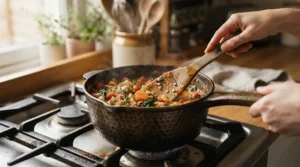
Week one: learn the burner. Match the pan to the element size, and keep the pan base and the glass dry. Appliance manuals generally advise placing only dry pans on the surface. Lift pans on and off rather than sliding them. Start at medium heat, because nonstick rarely needs more. Add a little fat before food, never heat an empty pan.
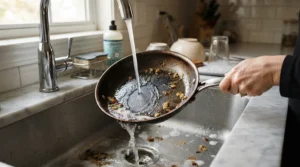
Weeks two to four: build habits. Use silicone, nylon, or wood utensils. Let pans cool before washing to avoid thermal shock, and hand-wash even if the listing says dishwasher-safe, since gentler cleaning generally extends coating life. Stack with felt or paper separators so one pan’s coating doesn’t scrape another.
Common first-month mistakes: cranking heat to preheat quickly, cutting food inside the pan, and leaving sugary spills on the glass, where they can fuse and pit the surface. Clean spills promptly with a cooktop-safe cleaner.
Real-World Scenarios: Which Set Fits Which Kitchen
Different kitchens need different answers, so here are three common profiles.
The first-apartment cook, $100 budget, cooking four nights a week. A starter lineup such as the Amazon Basics 8-Piece Nonstick Set keeps costs down, while the CAROTE 16-Piece Titanium Nonstick Set stretches a little further if cabinet space allows. Prioritize the straightedge test over piece count, because the goal is a base that survives a few years on a glass top.
The family of five, mixed-weeknight cooking, flexible $200 budget. The T-fal Ultimate Hard Anodized 14-Piece Set matches this profile, with its griddle, Dutch oven, and heat indicator. Large families cycle through pans quickly, so the broader lineup avoids the daily “everything is dirty” problem. Expect to replace the most-used fry pan first.
The weekend ambitious cook, higher budget, frequent oven finishing. The All-Clad HA1 Hard Anodized Nonstick 10-Piece Set suits stovetop-to-broiler cooking better than most sets, and the Calphalon Classic 10-Piece Set is a more moderate alternative. For anyone who wants no PTFE at all, the GreenLife 16-Piece Ceramic Nonstick Set fits, and the Rachael Ray Brights Aluminum Nonstick Set makes sense if style matters as much as specs.
How to Choose a Nonstick Cookware Set for Glass Top Stove
The best way to choose is to start with the base, then the body, then the coating, then your habits. Here’s the sequence that protects both your cooktop and your wallet.
- Confirm a flat, smooth base. A straightedge should show no daylight. Slight concavity when cold can flatten with heat, but convex or warped bottoms never work.
- Prefer rigid bodies. Hard-anodized or die-cast aluminum generally holds flatness longer than thin stamped aluminum.
- Check cooktop labeling. Look for explicit glass, ceramic, or induction compatibility on the box rather than assuming.
- Decide on coating. PTFE-based coatings usually last longer, while ceramic avoids PTFE but tends to wear faster.
- Match piece count to real cooking. A tight ten-piece set you’ll use beats a giant set you won’t.
- Weigh weight. The practical target, as one cookware guide puts it, is pans substantial enough to sit still yet light enough to lift rather than drag.
- Plan for replacement. Budget sets are short-term; premium sets reward careful use.
Flat Bottom Nonstick Pots and Pans Set: What “Flat” Really Means
A flat bottom nonstick pots and pans set earns its keep through full contact, not marketing language. Contact is how heat gets from the element into the pan, and it’s also how scratches are avoided. A warped base creates an air gap, which wastes energy and creates hot and cold zones that scorch food in one patch and undercook it in another.
Here’s the subtlety most shoppers miss. “Flat” isn’t only about the bottom of the pan, it’s about the bottom’s finish. A perfectly level base with a rough casting seam or embedded grit can still gouge glass. Smooth, polished, even finishes win.
When you’re comparing options, treat any flat bottom nonstick pots and pans set as a hypothesis until it passes a straightedge test at home. Heavy cookware also introduces risk: a dropped pot from even a few inches up can crack glass. Aim for solid but not heavy.
Scratch Resistant Nonstick Cookware for Smooth Cooktop: Protecting Both Surfaces
Scratch resistant nonstick cookware for smooth cooktop use really means two surfaces to protect: the glass below the pan and the coating inside it.
For the glass, the culprits are rough bases, casting seams, and trapped grit or dried food. Cast iron and unfinished bottoms are the classic offenders, which is why appliance makers advise caution with them. For the coating, the enemies are metal utensils, abrasive pads, and stacking pans without protection.
Hard-anodized and well-finished bases help, and ceramic coatings are particularly sensitive to scratching. Keep the habits simple. Wipe the glass and the pan base before every cook, lift rather than slide, and use soft utensils.
Truly scratch resistant nonstick cookware for smooth cooktop doesn’t exist in an absolute sense, so “scratch resistant” is always about reducing risk, not eliminating it. A flaking or peeling coating should also prompt replacement, since worn pans can leave residue on the glass.
Flat Base Stability: Why a Pan Should Sit Still
Flat base stability is the quiet hero of glass-top cooking. A stable pan won’t rock when you stir, won’t spin on the burner, and won’t slide when you flip food. It also keeps hot oil where it belongs.
Stability comes from three things: base flatness, adequate weight, and a base diameter matched to the element. Too light and the pan skates around on slick glass. Too heavy and you drop the risk of cracking or scratching. A cookware guide from Misen argues that glass cooktops turn any warp into a pivot that makes pans rock and slide, which is why substantial yet liftable cookware is the sweet spot.
In practice, test flat base stability by setting an empty cold pan on a flat counter and nudging it. If it rocks, it’ll rock on the stove. Flat base stability also affects safety, because an unstable pot of simmering liquid is an accident waiting for an excuse.

Smooth Top Compatibility: Reading the Box Before You Buy
Smooth top compatibility sounds like a marketing checkbox, but it’s a genuine spec worth reading. The label tells you the maker designed the base for ceramic or glass cooktops, not just for gas flames.
Check three things. First, look for explicit glass, ceramic, or smooth-top wording. Second, check induction compatibility if you might switch cooktops later, since induction-ready bases usually include a magnetic layer that adds rigidity. Third, confirm the manufacturer’s warranty terms, since appliance manuals typically tell you to follow the cookware maker’s recommendations.
Be careful with extras. Woks with support rings, pans with textured or ridged bottoms, and rough cast bases are routinely flagged as poor choices for glass. Good smooth top compatibility means a smooth, flat base and a coating rated for the heat you’ll actually use.
If the packaging doesn’t mention smooth top compatibility at all, ask the seller or manufacturer before assuming. It’s a two-minute email that can save a cooktop.
PTFE Coating on a Glass Top: Safe Use and Real Limits
A PTFE coating is what most people mean by “traditional nonstick.” The conversation around it has been loud, so here’s the measured version.
Healthline’s overview notes that the chemical PFOA, once used in making PTFE, has not been part of Teflon production since about 2013, and that the American Cancer Society says there are no proven human risks from new PFOA-free nonstick cookware. Healthline’s nonstick cookware safety overview also notes that research on broader PFAS compounds is ongoing, so the science isn’t fully closed.
The practical limit is heat. PTFE coatings can degrade when heated well above roughly 500°F (260°C), and overheated nonstick fumes are known to be dangerous to pet birds. On a glass top, that risk mostly comes from preheating an empty pan on high.
So the rules are simple: medium heat, never heat a dry pan, keep the kitchen ventilated, and replace pans with flaking coatings. If you’d rather skip PTFE altogether, ceramic sets like the GreenLife 16-Piece Ceramic Nonstick Set are the alternative, with their own durability trade-offs.
Nonstick vs Traditional Alternatives: Is It Worth It on Glass?
Nonstick isn’t the only way to cook on a smooth top, so here’s how the main materials compare.
| Material | Glass-Top Friendliness | Nonstick Ease | Longevity | Best For |
|---|---|---|---|---|
| Nonstick (T-fal, Calphalon) | Good when the base is flat | Excellent | Moderate | Everyday ease |
| Stainless tri-ply | Excellent, stays flat | Low | Very high | Searing, durability |
| Enameled cast iron | Fair, heavy risk | Moderate | Very high | Slow braising |
| Ceramic nonstick (GreenLife) | Good when base is smooth | Good at first | Short-moderate | PTFE-avoiders |
The table shows why many cooks keep a mixed kitchen. Stainless tri-ply wins on durability and flatness, while nonstick wins on eggs and cleanup. Heavy cast iron brings more scratch and crack risk on glass, which is why appliance makers urge caution. A sensible compromise is a nonstick set for daily cooking plus one stainless skillet for high-heat searing.
Long-Term Cost and Maintenance: What a Set Really Costs
Sticker price is the smallest part of the story. A cheaper set that needs replacing in two years can cost more than a pricier one that lasts five, once you count replacement cycles and your time.
Think in cost per year. A Amazon Basics 8-Piece Nonstick Set at the low end might need replacing sooner, while a Calphalon Classic 10-Piece Set or an All-Clad HA1 Hard Anodized Nonstick 10-Piece Set spreads a higher upfront cost across more cooking years, provided you treat them well. Lifespans vary a lot with habits, so these are reasoning frameworks, not guarantees.
Maintenance is mostly free: hand-wash, use soft utensils, avoid high heat, and store with separators. The expensive mistake is damage to the cooktop itself, since replacing a glass top costs far more than any cookware set. Protecting the glass is the biggest return on investment in this whole article.
Frequently Asked Questions
❓ Can nonstick pans scratch a glass top stove?
❓ How do I test whether a pan is flat enough for a glass cooktop?
❓ Is it safe to use PTFE nonstick at high heat on a glass top?
❓ Can I use induction-rated nonstick pans on a regular smooth top?
❓ How often should I replace nonstick pans used on a glass top?
Conclusion: Choose the Base First, the Brand Second
Choosing a nonstick cookware set for glass top stove cooking comes down to a short list of non-negotiables: a flat, smooth base, a rigid body, honest cooktop labeling, and habits that protect both the coating and the glass. After that, personality and budget decide.
If I had to map the picks to people, the T-fal Ultimate Hard Anodized 14-Piece Set suits busy families, the All-Clad HA1 Hard Anodized Nonstick 10-Piece Set suits frequent cooks who want oven versatility, and the CAROTE 16-Piece Titanium Nonstick Set suits value hunters. The Calphalon Classic 10-Piece Set and Rachael Ray Brights Aluminum Nonstick Set fill the middle, the GreenLife 16-Piece Ceramic Nonstick Set serves PTFE-avoiders, and the Amazon Basics 8-Piece Nonstick Set gets new kitchens started. For a broader view of the category, Bob Vila’s glass-top cookware guide shows how editors weigh nonstick against stainless options.
Run the straightedge test, check current prices, and cook at medium heat. Your cooktop will thank you quietly, which is the best kind of gratitude.
Recommended for You
- [Add your blog post link 1]
- [Add your blog post link 2]
- [Add your blog post link 3]
Disclaimer: This article contains affiliate links. As an Amazon Associate, I earn from qualifying purchases. If you purchase products through these links, we may earn a small commission at no additional cost to you.
✨ Found this helpful? Share it with your friends! 💬🤗
